A slip dress appears simple due to the fact that there are very few points where it is broken: slender straps, a clean neckline and a shape that clings close to the figure. Such simplicity leaves no place to conceal any production errors. A neckline that expands, a strap that lengthens or a seam that hangs unevenly at the side can transform the entire piece before the client notices the fabric.
To an OEM buyer, it is not only about approving a smooth sample. The same coverage, movement and visual balance across sizes, colors and production lots must be maintained in the commercial product. That means that the pattern, fabric, sewing method and pressing standard have to be approved jointly and not individually.
Spell Out What Skimming the Body Means for This Range.
The phrase “slim slip dress” is too open to interpretation. One brand anticipates a casual column which can be overlaid on a shirt; another anticipates a tight evening shape with a low cut. Prior to pattern work, determine the occasion, the intended undergarment, footwear, the garment length and amount of ease required at the bust, waist and hip.
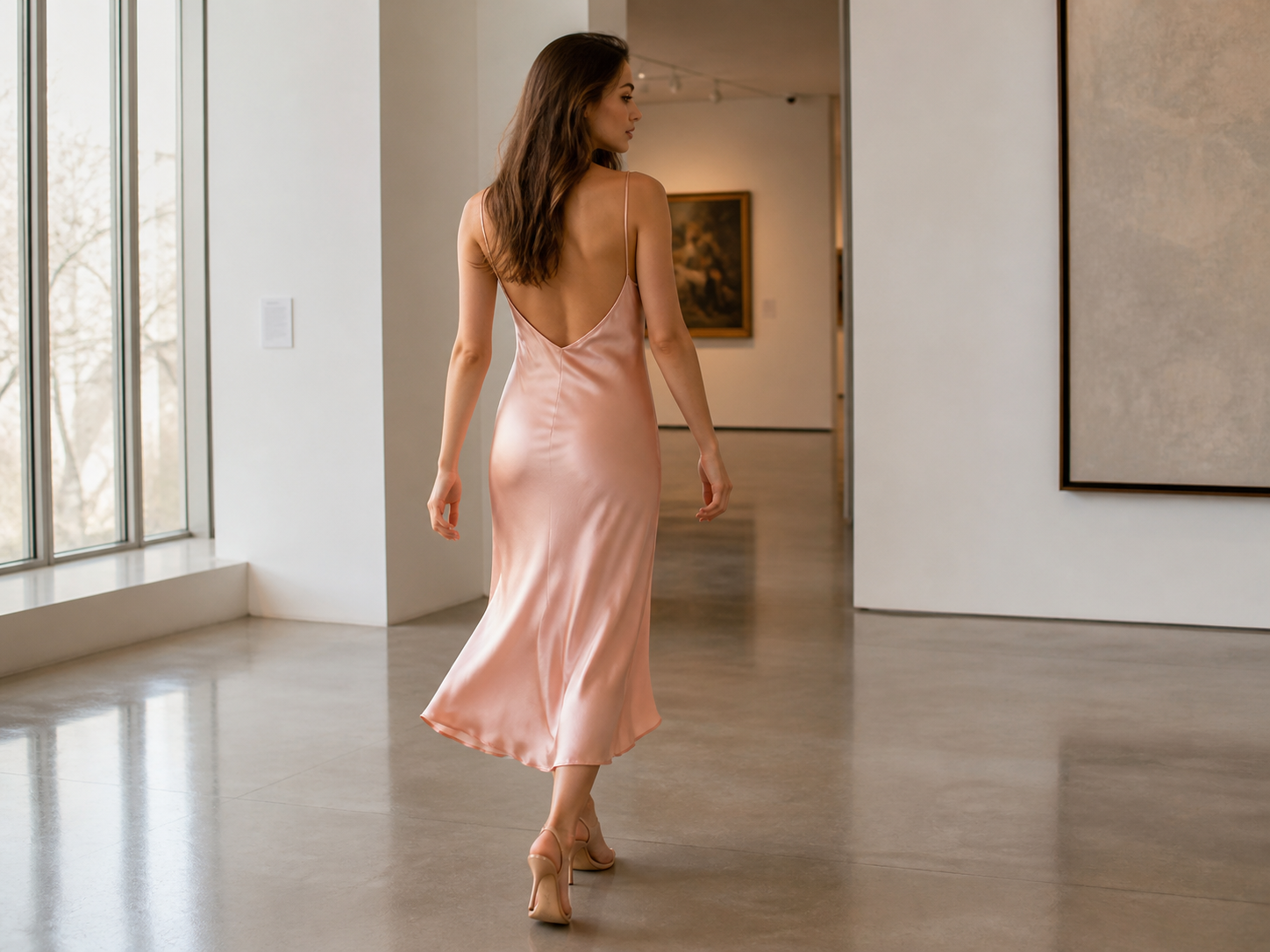
Approve movement, not only a standing photograph.
Ask the person to walk, sit, turn and raise both arms. Observe the neckline, armhole, slit and back opening instead of evaluating the front view only. When the dress must be adjusted every minute during a fitting, then the sample has not yet attained a consistent commercial fit.
Construct the Pattern along the Fabric Direction.
Most slip dresses utilize bias-cut panels since fabric cut across the grain can follow the form and create a flowing drape. Bias is not an aesthetic term, however. It changes how the panel stretches, where the side seam hangs and how much the garment may lengthen after cutting. The pattern and cutting plan should state the intended grain direction of each main piece.
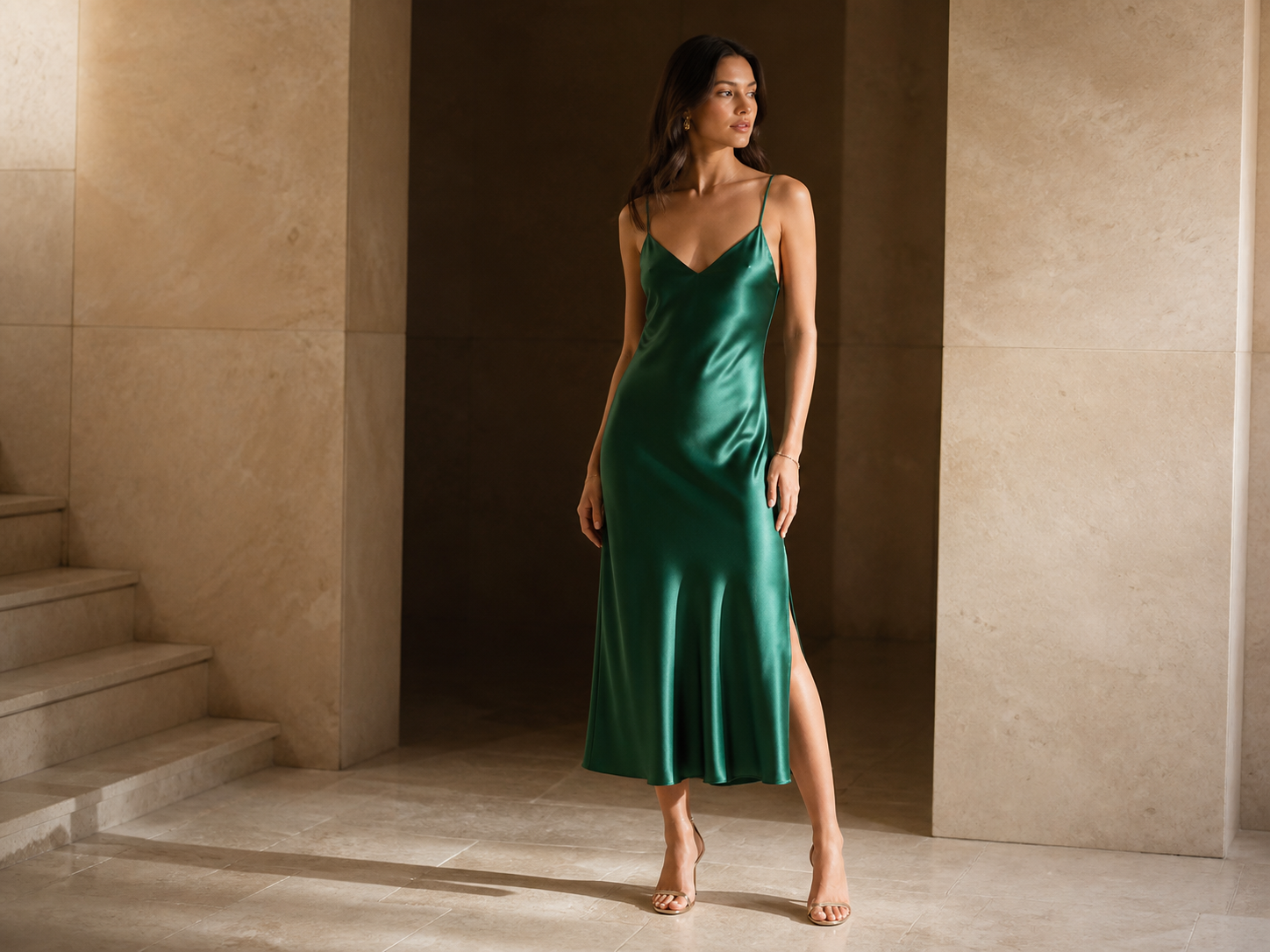
Allow the cut panels to settle before hemming.
Cut panels must be allowed to rest before the final hem is marked. When the hem is marked while the panels are still growing, the dress can leave the factory level and it will be uneven when it is on the hanger. A controlled hanging period and a second length measurement provide the hem with a more solid frame of reference.
Treat the Neckline and Straps as a Load-Bearing Unit.
The straps define more than just shoulder placement. Neckline depth, armhole coverage, bust position and the final hem are all influenced by strap length. Even a stretch of a few millimeters at every attachment point can cause a low neckline to be significantly lower, particularly with a soft or heavy piece of material.
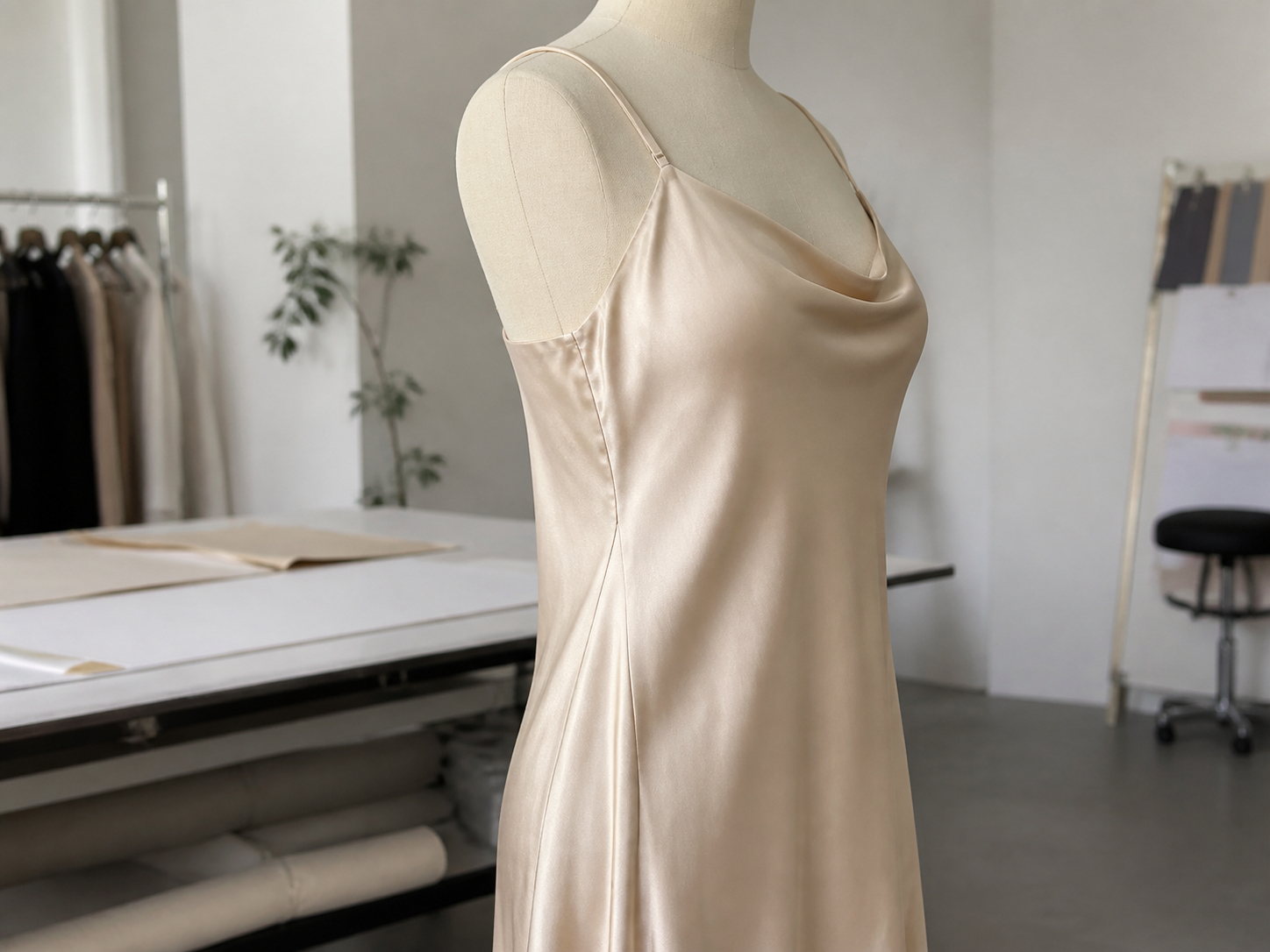
Note the checkpoints used to control coverage.
The sample approval ought to have measurable landmarks rather than being based on “looks right”. Note the following under the same wearing conditions:
- Finished strap length and how far it can be adjusted.
- Measure neckline depth from a fixed shoulder or high-point reference.
- Armhole depth and coverage of sides with the desired undergarment.
- Gap between front and back straps.
- Strap joins and adjuster hardware reinforcement method.
Specify Fabric by Performance, Not Only by the Word Satin.
Satin refers to a surface construction, not one fixed material. Polyester satin, acetate blends, silk blends and satin-back crepe may vary in weight, shine, static, recovery and resistance to snagging. Two fabrics would appear similar in a swatch but might behave differently once cut into long panels.
Review fabric vertically and in motion.
The development brief should encompass weight, usable width, stretch and recovery, opacity, face and reverse, desired shine and care method. Observe the piece of fabric when hanging and observe it in motion. A flat desk test will not reveal every ripple, cling line or change in reflection.
Determine at which points the dress requires support without causing it to be heavy.
An entirely lined slip dress will lose the lightness with which the style was appealing, whereas an unlined one may display seams, underwear or pocket bags. The appropriate solution will be based on color, weight of the fabric, their target price and the wearing occasion. Potential solutions involve a partial lining, a distinct inner layer, selective facing or a carefully selected full lining.
Test the dress under the light in which it will be sold.
Test pale and dark colors in daylight, fitting-room light and flash photography. The same construction may not work for every color. When a change in lining is only necessary for certain shades, record that variance in the bill of materials and costing and not in the form of an informal production change.
Grade the Silhouette without Moving Its Character.
Adding the same amount at each seam cannot maintain a slip dress. The bigger sizes might also require additional bust capacity, different armhole coverage and a new strap location that does not necessarily involve extending the neckline. Smaller sizes may also come to lose their intended proportion when the slit, back depth or trim width is mechanically trimmed.
Fit the smallest and largest development sizes.
Examine at least one smaller and one larger graded sample on the body. Compare: neckline depth, bust coverage, waist position, hip ease, slit height and finished length. This is not aimed at making all sizes look alike but to maintain the same design purpose and level of protection.
Guard the Surface between Cutting Table and Delivery.
A clean slip dress can be spoilt by seemingly trivial occurrences in a busier garment. Blunt needles can pull yarns, rough tables can create snags, ironing can add a shine, or leave seam impressions, and metal adjusters can be left to mark the cloth during transit. Handling standards must start prior to sewing and proceed to packing.
Open a trial carton before release.
Bulk inspection encompasses panels viewed under uniform lighting, smooth strap adjustment, balanced side seams, level rested hem and closures that do not distort the fabric. Pack a trial carton and re-open it after storage. In case the dresses need lots of steaming, or reveal impressions of hardware, adjust the fold or add suitable protection prior to delivery.
Accept the Whole Slip Dress, Not an Assemblage of Details.
A dependable slip dress is produced when drape, coverage and length work together. Direction of fabric influences side seam; strap length influences the neckline and hem; lining influences weight and movement; pressing influences the visible surface. To approve each of the elements individually may still result in a garment that does not work.
The final approval sample must reflect the fabric, construction, hardware, intended care process and packing system. Store its measurements, photos and reference materials for bulk checks and reorders. The evidence provides a common standard for Siyinghong and the buyer without turning a minimal design into an ambiguous one.
FAQ
Should all slip dresses be bias-cut?
No. Structured, stretch or relaxed styles can be built on the straight grain. When bias cutting is applied, the direction and relaxation process must be regulated since this influences the stretch, drape and finished length.
When should the hem of a bias-cut slip dress be finished?
The panels are to be first sewn and allowed to relax under controlled conditions. Check the garment length and balance again before marking and finishing the final hem.
Should all colors use the same lining?
Not automatically. Pale colors may require more opacity, whereas dark colors can be acceptable without a complete lining. Test all colors under realistic light and record color-specific construction in the bill of materials.
What should a buyer add to a slip dress OEM enquiry?
Include the target customer, occasion, silhouette, length, size range, fabric performance, grain direction, neckline and back depth, type of straps, lining, location of slit, quantities, care method, packaging and delivery date.
Post time: Sep-02-2026