A shirt dress can be identified with ease and quite readily blurred. More or less ease will make it an overshirt or a tight shirt, respectively. The issue of a wholesale buyer is not to discover a single appealing sample. It is determining what information constitutes the shirt dress and maintaining that information consistently across all materials, sizes and order repetitions.
To develop wholesale, useful decisions that can be approved and measured are the beginning of the useful work. It should have a stable base that is not pressurizing the factory to re-do the product every season, as the new color or sleeve treatment will be applied.
Assign the Style a Particular Job in the Range.
Determine the place of the dress in the life of the customer before talking about trims. Office, traveling and relaxed weekend versions might have the same button front, but each will require a different combination of finish, movement and interior support.
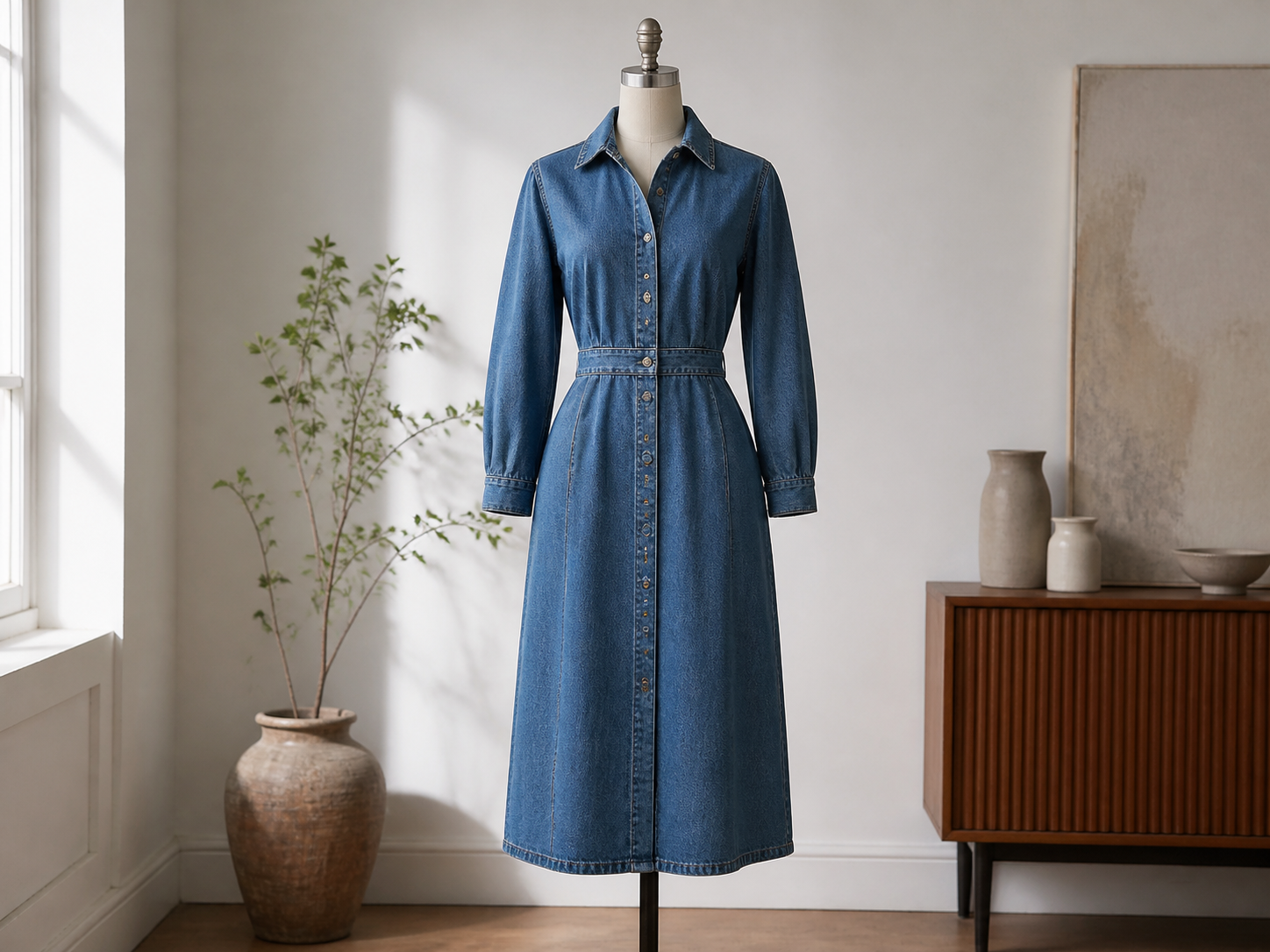
Before you can speak of the trim, describe the wearer.
Record the time, weather, layer to be used and amount of finish required. This determines whether the dress requires a sitting ease, a walking ease, flexibility of the sleeves or a more restrained waist.
Prepare a sentence to be proved by the sample.
One of the statements that could be useful is the following one: a sharp midi shirt dress that will resist gaping during a working day. It provides a better target to the pattern maker and sample room than classic and elegant.
Keep the Shirt-Dress Identity Safe.
A customer tends to identify the product by its shape and front line before paying attention to minute decoration. Shoulder position, collar scale, placket width and button rhythm therefore are more important to identity than a stuffed list of features.
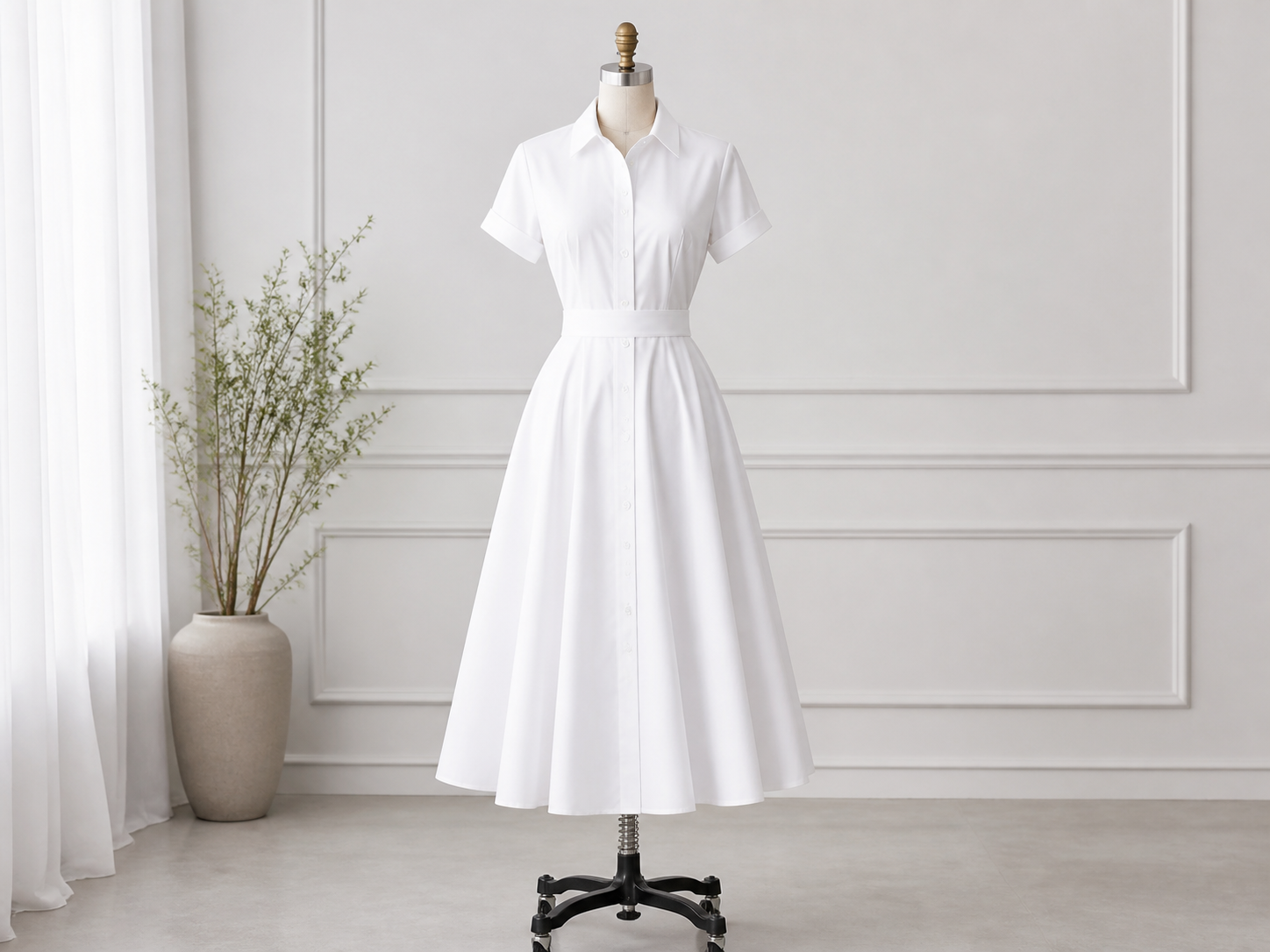
Determine what features must not drift.
The identity points include the collar proportion, front opening, position of the waist and the general length. Other details can change seasonally without recognition being impaired.
Do not have rival points of focus.
Any of these items can work, but a huge collar, huge pockets, a huge belt and huge cuffs tend to make the product more difficult to price and move.
Build for Movement, Not Posing.
A showroom pose cannot approve working fit. The dress must also lie properly after the wearer has reached, stood and walked or acceptable bust and waist figures might be hiding armhole drag or an opening button front.
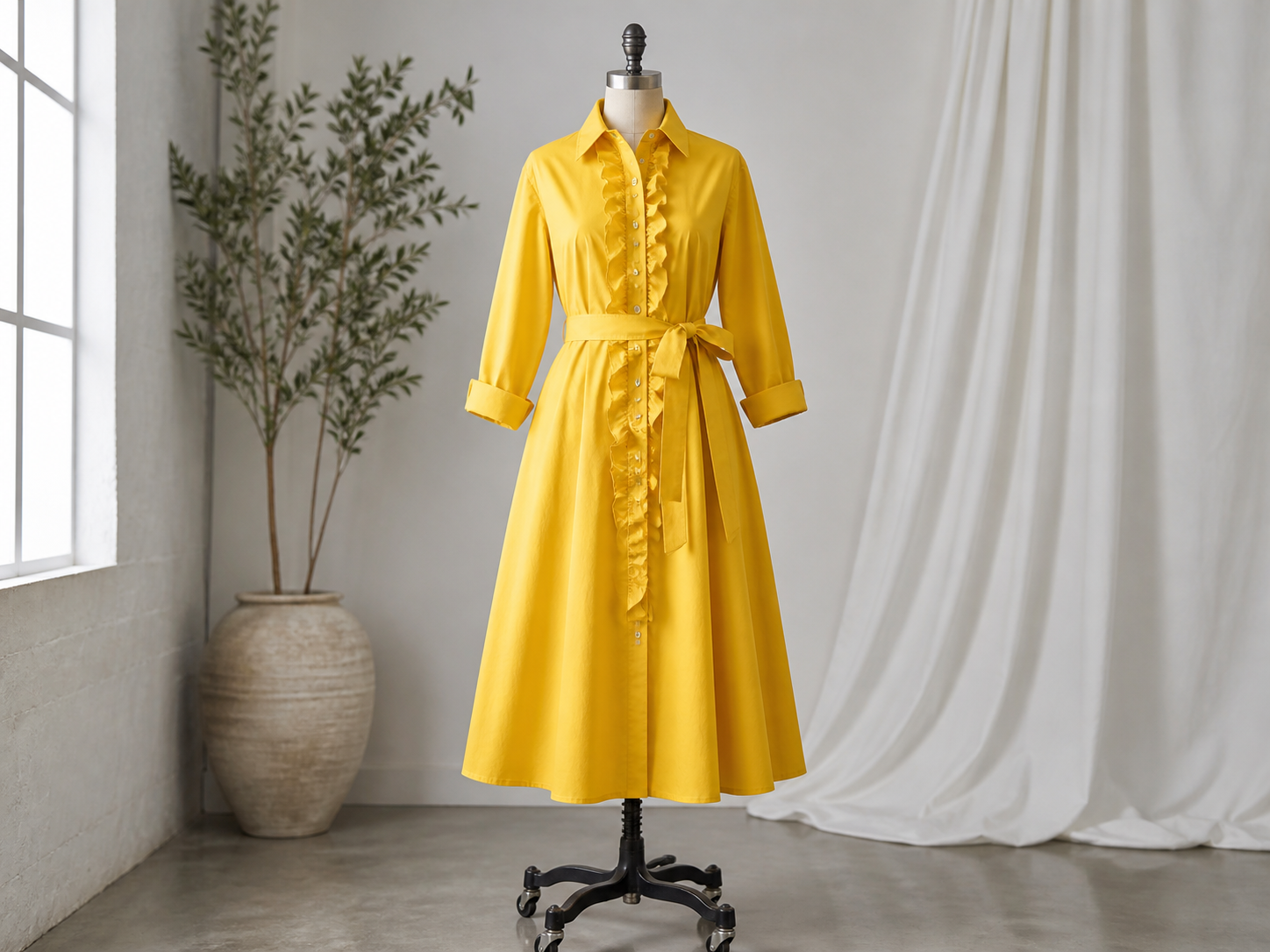
Tension on the placket.
Button the dress. Horizontal strain, pushed buttons or a front hem which lifts can be a sign of lack of ease, bad shaping or a loose placket instead of a button-spacing issue.
Movement: Check the back.
See the yoke, shoulder blades and waist once the wearer gets forward. Pattern correction is required as useful movement ease should be restored to position; any excess volume that has remained trapped below the yoke requires pattern correction.
Decision Making: Make Collar and Placket Decisions together.
The collar originates in one of the working groups, which include neckline, stand, leaf, interfacing and top closure. The front is naturally relaxed or is carefully tailored by their relationship.
Accept the collar in the two positions desired.
In case it can be worn open and closed, take a photograph and measure it. Record stand height, point length, spread and neckline pulling on buttoning the top.
Examine the entire front line.
Fusing, sewing and pressing should not cause the placket to bend. Small deviations can be more noticeable when using stripes, soft fabrics and long fronts; the approval sample must be seen both at a distance and close up.
Select a Waist Solution that the Customer Knows.
Treatment of the waist alters the fit and customer expectation. Darts, elastic, seams, drawcords and separate belts cannot be regarded as alternative solutions, they should not be applied because of the need to save the shape of a body which is not resolved.
Use a belt as a fitted part.
Indicate completed length, width, position and construction of the loop. Check: Does the belt remain flat when sitting and do the loops stretch the side seams?
Be true to an unbelted version.
In case the dress is depicted without a belt, it is essential to make sure that the body still has an intentional proportion. A product in which tying is mandatory to wear can have returns when customers wear it in a different manner.
Choose Fabric by Behaviour.
Relevant directions are cotton and cotton blends, linen and rayon, denim, polyester blends, poplin and twill as seen on the shirt-dress page by Siyinghong. Each alters the equilibrium of structure, drape and care.
Test the actual construction package.
Evaluate shell, interfacing, thread and seam together. A light rayon will probably require a support at the opening, whereas a heavy denim one might require less bulk at the collar and cuff.
Indicate the condition of measurement.
Indicate unwashed, washed, steamed or fully pressed measurements. Without that note, shrinkage and pressing will let the same garment pass one inspection and fail another.
Grade Visible Landmarks Deliberately
Even a mathematically graded body may appear incorrect. The pocket height, the position of the waist, the placement of the buttons and the size of the collar require their own review since the customers consider proportion, rather than the grading calculation.
Check the extremes of the size range.
Test the smallest and largest sizes, as well as the base size. Compare shoulder-to-waist and waist-to-hem proportion and look over the closest button to the bust.
A landmark list should be given to the grader.
- Collar and stand scale across the range.
- First visible button and bust level button positions.
- Pocket to waist and side seam.
- Belt-loop height, cuff depth and finished hem level.
Bulk with Evidence.
Sample approval must be evidenced by another production team months later. Measures must be placed next to pics and observable checkpoints as opposed to relying on memory or informal messages.
Make the approval pack small.
Add the approved version of the pattern, measurement chart, fabric and trim references, construction notes, graded rules and front, side and back photographs. Eliminate redundant remarks to ensure that the team is not making decisions between versions.
See what the customer observes first.
- Even after pressing, collar points are symmetrical.
- Placket is straight and does not move.
- Waist characteristic and pockets are flat.
- Side seams, hem and sleeve detail are within the approved balance.
Plan Differences without Restarting Development.
The seasonal change is safer when the brand no longer relies on permanent identity, but rather on changeable information. Mark that distinction when bulk is approved so that a new sleeve or fabric does not inadvertently change the original fit logic.
Repeat the right tests upon fabric change.
A new fabric needs a new analysis of shrinkage, transparency, drape, interfacing and seam look. It does not necessarily demand the modification of all the pattern choices.
Preserve reorder information.
Keep final fabric-lot notes, trim references, pattern version and inspection findings together. Reorders are not as risky as the factory can trace the approved product but not rebuild it based on messages.
Conclusion
The small number of relationships that are considered to be clear when it comes to a dependable shirt dress include shoulder to collar, body ease to placket, waist treatment to proportion, and fabric behaviour to construction. When such relationships are registered, a buyer is able to create variety without losing any fit or identity of products in bulk.
FAQ
These questions include aspects that buyers usually have to resolve before trying or requesting a shirt dress program.
What is included in a shirt dress tech pack?
Add silhouette, fabric, measurements, construction of collars, plackets, spacing of buttons, treatment of waist, position of pockets, sleeve and cuff, labels, stitching, finishing and measurement condition.
What can be done to decrease button-front gaping?
Check ease, shaping, button placement, placket stability and buttonhole direction on the worn sample. The addition of buttons would not necessarily fix the fit problem but only conceal it.
In what sizes should bulk be sampled?
Check the base size and verify important sizes at each extreme of the planned range. Similar attention should be given to visible landmarks as to circumference measurements.
At what time is shrinkage to be tested?
Test shrinkage before locking final measurements, and repeat the test when the fabric or finishing changes.
Post time: Sep-08-2026