A maxi dress normally borders on the ankle region or the ground whereas a midi dress touches lower than the knee and above the ankle. The critical requirement is that the labels identify the position of a dress on the wearer. One dress can pass as midi on one individual, and maxi on another.
When considering maxi dress vs midi dress online, start with measurements and not category name. The length of the product, where you set the waist, what sort of a skirt you are going to wear, the shoes you are going to wear, can tell you more than a model photograph. This book can be used to understand a listing into a realistic image of fit and choose whether a change would make the outcome any better.
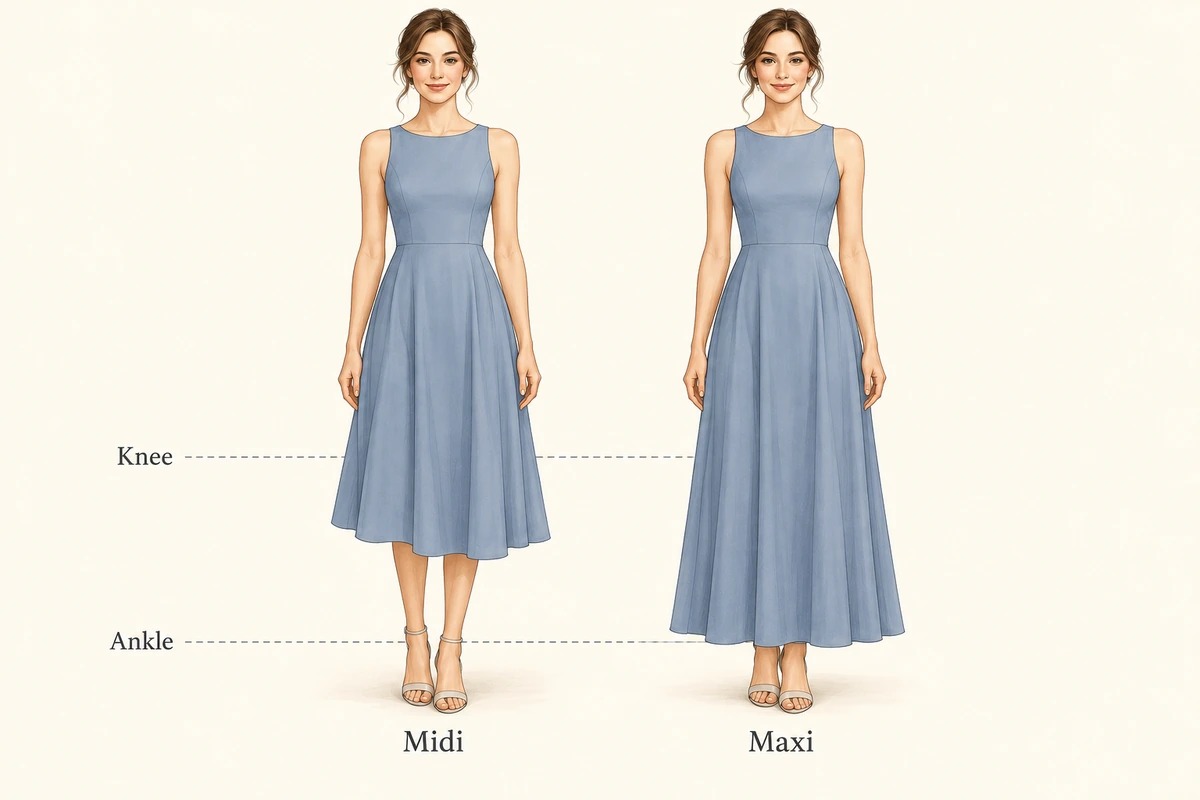
Find Your Hem On Your Body.
Midi and maxi do not mean the same thing, that is, they are not universal lengths in inches. A midi may be below the knee or at way below the calf. Depending on the design of the maxi and the wearer, the ankle may be on display or skim the shoe or even the floor.
The latter differences influence the extent to which the shoe is exposed, and the actions of the skirt upon walking. Two maxi-labeled products can thus be quite different. One could be convenient to use in daily movement and the other one requires thorough use around steps or rough surfaces.
Take a dress that you already have, as a model. Put it on and the place of where you want the new hem to be is where most of you need to be. As much as possible, measure the reference with the method that was stated by the retailer. This provides you with a case-pad reference as opposed to a blanket rule of applying only height as a criterion.
Read the Measurements Before the Name.
Test the point at which the mentioned length commences. A shoulder measurement cannot be directly substituted with a waist or a strapless bodice top. In case the listing fails to spell how it did so, consult the retailer prior to using the number.
Draw a comparison of the product measure of the measurement with the same measure of your reference garment. Do not stretch the garment but leave it flat unless the seller tells otherwise. Detachable straps, stretchy areas and curvy tops might not necessarily be comparable and taking note of them instead of thinking of a perfect fit is better.
The height of models is relevant background, but not enough to prove your finding. Torso length, the place of the waist seam and the choice of size are significant. Two persons of different height might have a varying position of the waist as a result of a shorter torso in one.
Confirm whether there is a change in the length of garments with the sizes. There are only a few listings which include a single sample measurement. When you are selecting another size, enquire about the information. Exact fit will be of great importance when the dress has a border, slit or ornamentation that will make it difficult to shorten.
Suppose an internet comparison. Dress A is called midi and the distance between the shoulder and hem is given; Dress B is called maxi and gives the distance of the top of the strapless bodice. The two figures cannot be directly compared to each other as they start at different levels. You must have either comparable gauging mechanisms, or an appropriate reference garment, to every model.
Now assume that both listings give the same route of measurement. Compare them with your reference dress, though, inspect a waist seam and shape of the skirt. The fit of a full skirt can be different as compared to that of a narrow skirt. Adjustable straps can shift the whole garment and an asymmetrical hem can possess multiple lengths that apply.
Make a simple note by each listing: position of expected hem, known measurements and unanswerable questions. Without an important detail, queries must be made to the seller and not out of guessing the model and its height. This comes in handy particularly when it is inconvenient to get the dress back or when you have a definite date you have to be in the dress.
Do not have many sizes of doubtful sizes simply because the label sounds good when the listing cannot clarify the length of the garment. Another advantage of a more clear product description can be more valuable than a more attractive category name. The right information assists to evaluate fit and change requirements to save money.
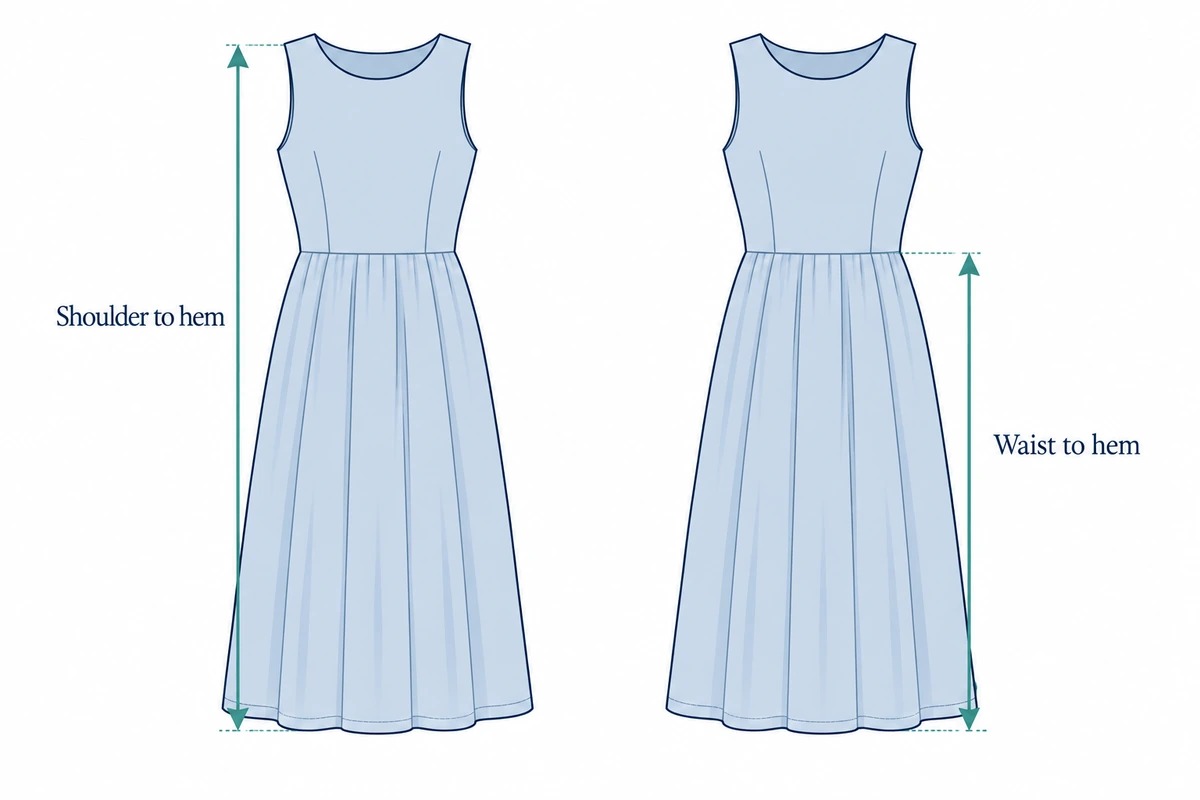
Compare Waist Placement and Skirt Volume.
Existing in longer hem is not necessarily going to produce a longer visual line. The proportion is determined by the relationship between the bodice, waist seam and skirt. When the waist seam is lower than desired, the top part of the body can be made to look longer than the skirt is.
Experiment with a defined waist when you want the appearance of a clear separation; or a straighter silhouette when you desire unbroken appearance. Both are not obligatory with a specific body type. The question here is, does the garment achieve the effect you are liking and whether it fits comfortably around the bust, waist and hip.
The amount of the skirts alters the comparison. A complete midi shows the bottom leg but provides fatterness with the skirt. A slim maxi produces another line and might require a slit or adequate hem circumference to walk. Check out the side and back perspectives, not just the front.
When any dress seems clumsy, find out what causes this problem and do not accuse this dress of clumsiness by its length. The issue could be too much fabric on the waist, a misplaced seam or a non-stretchy fabric that is larger than anticipated. Making the hem shorter will not be a solution to such problems.
Test the Length Using Your Shoes of Choice.
Wear the real shoes and one can make a verdict about a maxi hem. The front part is to take a step comfortably whereas the back part must act accordingly, based on the purpose of the garment. A trailing evening dress deliberately trailing has other different requirements than a maxi worn casually in everyday life.
In the case of a midi, look at the gap between the hem and shoe. Another visual separation is achieved by an ankle strap or boot shaft or high vamp. You might like that contrast, or you might want a quieter shoe which leaves a more unbroken line. One way is not necessarily better than the other.
Make photos of normal standing position at the front and side. Do not hold the camera at a steep angle, up or down. The one-and-the-same perspective simplifies the process of comparison of outfits, not confusing camera distortion with a fitting issue.
When you anticipate the wearing of both flats and heels, then determine which pair is the most important. The behavior of one hem might not be equally fine concerning entirely dissimilar shoe heights. A slightly shorter everyday maxi might be more convenient instead of a length that would only fit a pair of shoes you rarely have on.
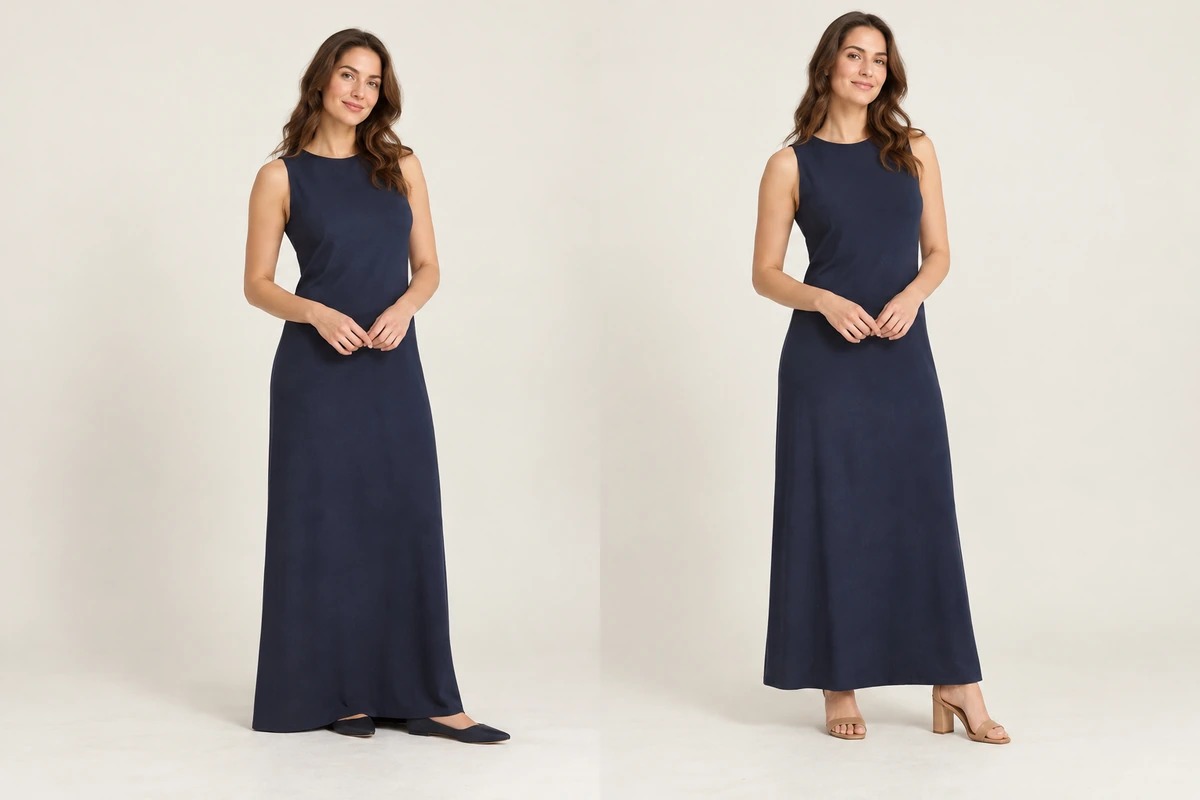
Match the Dress to Your Destination and Location.
On a day when you travel by bus, train, etc., do use the clearance of a maxi. Midi can ease those motions, but a strip-thin midi can still limit stride. The only part of practical fit is length.
To travel, consider the packing, sitting and the surface you are going to. Easy to fold long skirt can be comfortable but a structured fabric can take up more space in the luggage. Refer to the care specifications instead of thinking that a certain length is convenient to keep.
Ground conditions are as important as the venue photograph at an outdoor event. Both shoes and hems are susceptible to gravel, grass and wet paths. A longer dress can still be good provided that it is cut and clear in such situations.
Maxi should not be used as a synonym to formal. A casual maxi jersey and an elegant evening maxi are both designed with the same length yet they are used in different ways. Similarly, a midi may be applicable to most of the fancy occasions when the manufacturing and styling are in tandem with the invitation.
Decide If a Change Is Worth Doing.
Reducing a plain, simple hem can be comparatively easy, but it is the reality of the work that is defined by the actual garment. Lace edging, scalloped edge, pleated skirt or band of decoration can require a more complicated method to still maintain its look.
View slit placement then adjust length. When a large piece of fabric is taken off the hem, it alters the ratio between the cut and the rest of the skirt. A lining might require a distinct adjustment, and a curving or uneven hem ought to be marked carefully.
Request an alterations professional to determine whether or not making a change in the hem is going to get you the desired effect. When the waist seam is off-center, it may be tightened, but still lead to the same problem in the main proportion. Get the estimate prior to the commitment particularly when the purchase is in any case refundable.
Take desired shoes and undergarments to a try on. Pose in a natural way and indicate how you would wear the dress. One hem to a sitting, formal affair could be as different a hem to a stroll about all afternoon, as in a summer day. Note down the last measurement to use again in shopping.
Measurement Checklist Before an Order.
| Detail to verify | Why it matters |
| Original position of length and measure. | Makes comparisons meaningful |
| Selecting your size to be measured. | Eschews use of sample size alone. |
| Waist seam position | Decides how much the bodice is in relation to the skirt. |
| Shape, location of slit. | Influences movement and change possibilities. |
| Lining length | Influences coverage and how layers move |
| Your shoes to make comparison with. | Determines attainable floor clearance. |
Once these have been checked, select the type of dress that suits what you want to do. In case there are two possibilities, calculate the degree of uncertainty. A well assessed midi with proper proportions could be a safer buy compared to a maxi whose length details are not complete or the other way round.
Stable measurement guidelines can be the treasure of the brands as the category label. A useful product brief determines the point at which length begins, its variability with size and the footwear that the design envisages. The midi dress service by Siyinghong becomes a point to start discussing such kinds of fit requirements in a collection.
Post time: Oct-25-2026