Within the context of fashion, the wider meaning of dress is a one-piece garment that includes a skirt whereas gown frequently refers to the dress that is meant to be worn at a special occasion or even a formal occasion. The terms are not exclusive of each other. A dress can also be called an evening gown, otherwise a normal dress will not be referred to as an evening gown.
Knowledge of gown vs dress is thus not about determination as such but more about the correct reading of the product description. Retailers have a mixture of overlapping names and these names do not fit a specific length, price or construction. It is more convenient to learn how the terms are interrelated and do shopping and product planning.
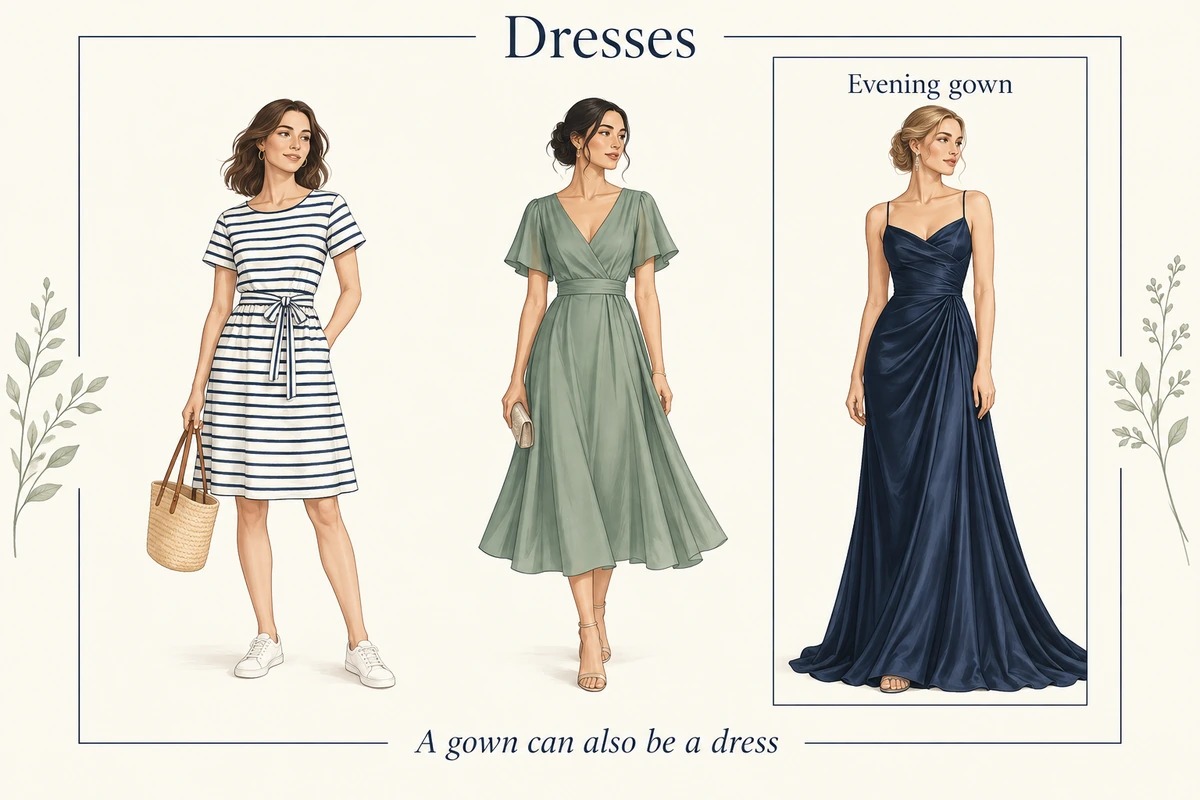
Understand the Relationship Between the Words
Dress exists as a large category and it holds within it lots of uses and silhouettes. It can include a shirt dress, an informal knit dress and a formal evening dress. Gown pulls the context thin in most fashion descriptions, most often towards ceremonial or formal clothing.
This article is about fashion retailing. Gown is also used in the terms of academic, medical and other garments, where its meaning is different. Nowhere does that assist you in making a decision about what you want to wear at a party and how to make sense of a list of fashions.
Within fashion, the boundaries remain flexible. A retailer might name a refined long design an evening dress, evening gown or maxi gown. The words provide a starting point, but the garment details establish what you are actually buying.
Inquire what the name contributes. In case it mentions only a more glamorous mood without specifying fabric, length or fit, you still require the specifications of the product to choose.
See How Retailers Use Gown
Evening gown
This commonly describes formal eveningwear, often with a long skirt. It may be simple or heavily embellished. The label alone does not tell you whether it has internal support, a train, sleeves or a fitted waist.
Bridal gown
This identifies an intended wedding role rather than a single silhouette. Bridal clothing can vary widely in length, color and construction. Look for the actual design details and the wedding context instead of assuming that every bridal gown follows one visual formula.
Ball gown
In retail descriptions, ball gown often signals a fitted upper body and a full skirt. It can refer to a silhouette as well as a formal garment. Skirt volume affects movement and seating, so confirm the structure beneath the outer layer.
These terms assist in organizing a store, without having to replace the invitation. An evening gown might be too fancy to wear to one event and just right to wear to another. How appropriate the event is defines appropriateness; the category name will assist you in locating candidates.
Inspect Construction Instead of Assuming It
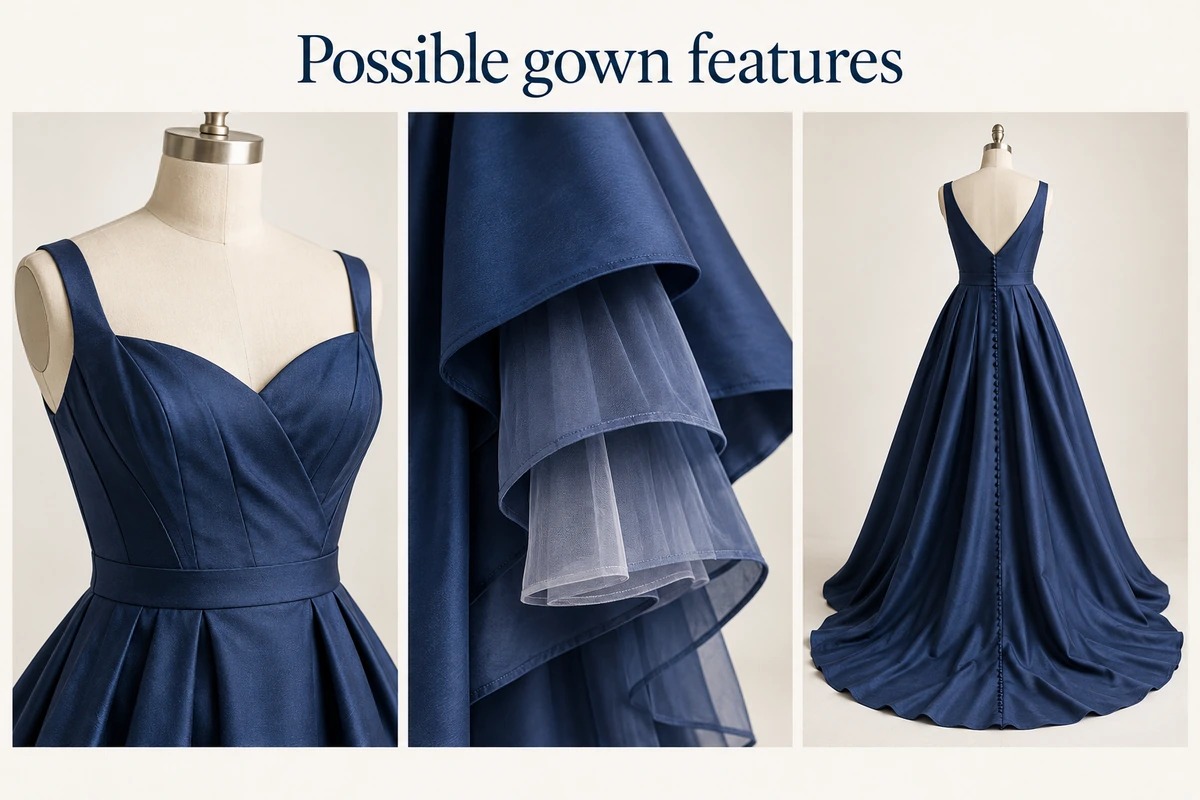
A gown may use an internal bodice structure, several skirt layers, carefully shaped seams or a train. These can support its intended silhouette, but none is required in every gown. A fluid, minimal design can still serve a formal purpose.
Examine the neckline and fastening. Does the product information explain how the garment stays in place? Are straps adjustable, and does the back allow the support you prefer? An attractive front image can leave those practical questions unanswered.
Look at the skirt from more than one angle. A full front view may conceal a trailing back hem. A close-up may reveal whether a decorative surface covers the whole garment or only selected panels. Confirm what is included rather than assuming that every styling item in a photograph comes with the dress.
These details also help when communicating with a maker. Saying that you want a gown leaves considerable room for interpretation. Specifying a fitted bodice, soft A-line skirt, no train and a particular hem intention gives a clearer starting point.
Explain Why Floor Length Does Not Automatically Mean Gown
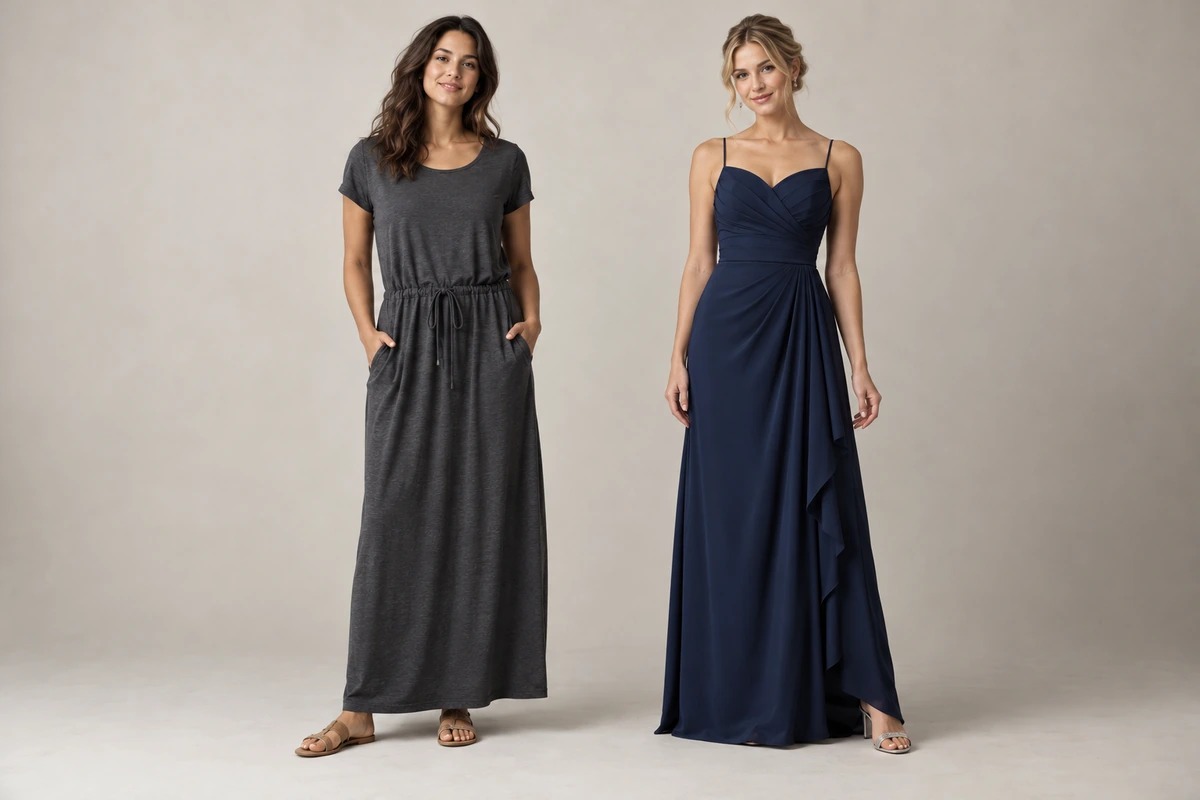
Length is a measurement; gown is a usage-dependent description. A relaxed long dress designed for a beach holiday can reach the floor without becoming formalwear. Its fabric, neckline, finish and styling may all point toward casual use.
The reverse also deserves attention. A shorter dress can be highly dressed up, although retailers may be more likely to call it a cocktail or evening dress than a gown. There is no benefit in forcing every garment into a perfectly separate naming box when the market itself uses flexible terms.
Compare two hypothetical garments: a soft jersey maxi with a casual drawstring waist, and a floor-length crepe dress with a carefully shaped bodice. Both are long dresses. The second may be described as a gown because of its intended formal use, while the first remains casual despite a similar hem position.
Use this distinction to avoid buying by silhouette photograph alone. Search for the garment’s intended occasion and inspect its construction before deciding that it satisfies a formal invitation.
Correct Common Naming Myths
The word gown does not guarantee a higher price or better quality. Material, labor, brand positioning and design complexity can all affect cost. A poorly finished gown does not become a better purchase than a well-made dress because its name sounds grander.
Dress does not mean casual. The term includes many formal garments. If a retailer calls a product a dress, you should still assess whether it could satisfy the invitation rather than excluding it immediately.
A gown does not have to be covered in decoration. Minimal formalwear can rely on proportion, fabric and precise finishing. Similarly, heavy embellishment does not automatically establish an appropriate formal silhouette or good fit.
Finally, gown is not a promise that alterations will be easy. A simple-looking garment may use delicate seams or a complex lining. Ask an alterations professional about the actual construction instead of estimating the work from the product title.
Search with Three Kinds of Information
Begin with occasion. Evening reception, wedding guest and formal gala point to other potentialities. Next attach the shape that you want, like column, A-line or full skirt. End with a handy item or construction choice, like crepe, sleeves or no train.
For example, a search for a long-sleeve crepe evening dress with no train communicates more than a search for gown alone. A bridal A-line gown with a defined waist describes another need. The purpose is not to produce the longest search phrase, but to include the details that would make you reject an unsuitable result.
Read past the title when a good listing is found. Check composition, lining, closure, measurements and care. When the name of the products is silk, but the composition itself is not clear, inquire about it. When the picture is floor-length, verify the measure of the garment and where it starts.
Store the practical specifications of clothes that you like. The vocabulary will become more accurate as you advance. Then, you are able to compare products in one retailer with another where they do not have corresponding category names.
Imagine two listings with almost identical photographs. One says evening gown and the other says occasion dress. Before assuming the first is more formal, compare the measurements, fabric composition, lining and back view. You may find that the second has the more refined construction, or that both serve the same purpose. The labels alone cannot establish the result.
The same discipline helps when asking a store for alternatives. Instead of saying that a gown looks too much like a dress, identify what you want to change: more skirt volume, a longer hem, a more structured bodice or less casual fabric. Those requests describe features a seller can respond to.
Separate internal naming with customer information, in the case of product teams. An assortment can merchandise based on gown, but still, descriptions as to why it is so should be given. When multiple styles have the word, clarify what each is helpful: one is a more manageable straight skirt, another provides a fuller cut, and another can be sleeved and has a high neckline.
Consistent vocabulary also improves conversations during fittings. Record whether a comment concerns length, shape, support or finish. A request to make a sample more gown-like is open to several interpretations; a request for a fuller skirt with the current waist position gives the team a concrete change to evaluate.
Keep a Practical Product Description Glossary
| Term | What it helps describe | What still needs checking |
| Dress | Broad garment category | Occasion, shape and construction |
| Gown | Often a formal or ceremonial context | Actual design and event suitability |
| Maxi | Long hem category | Measurement and floor clearance |
| Midi | Hem below knee and above ankle | Where it falls on you |
| A-line | Shape widening toward the hem | Amount of volume and fabric behavior |
| Train | Fabric extending behind the garment | Length and management during wear |
| Lined | An additional inner layer | Composition, coverage and attachment |
Treat the glossary as a way to ask better questions. Several terms may describe one garment at the same time: a lined A-line maxi dress could also be sold as an evening gown. That overlap is normal.
If you are writing product copy, describe the concrete garment before adding mood. A shopper benefits more from knowing the closure, lining and hem than from repeated claims that a design is luxurious. Accurate language also makes comparisons easier across a collection.
For brands planning formalwear, use gown as a category cue and then specify the details that matter in a sample. Siyinghong’s evening dress service provides a relevant place to discuss that brief. Clear terminology reduces ambiguity, but measurements and construction decisions are what turn the name into a wearable garment.
Post time: Oct-23-2026