Accessories are not placed next to a black dress. A necklace rests against its neckline, a belt pushes into its waist, a bag glides across its surface and a shoe hits the hem each time the wearer walks. The contact spaces determine whether an outfit will remain polished beyond the first photograph.
Black emphasizes minute details and it may mask them. Instead of adding jewelry, a bag and shoes in that order, place whatever you are adding wherever it will come in contact with the dress. Retain it if the dress and other details still work together in motion and light.
Read Black Cloth Before Adding Shine.
Black cotton, velvet, satin and sequins do not provide the same background. Matte fabric absorbs light and provides a clear background for polished metal. Satin echoes surrounding highlights, and velvet gets deeper with the movement of the pile. Sequins already provide their own rhythm.
Check the dress in the event lighting.
An object that appears separate when seen near a window can become hidden in a dim room, or noticeably bright when viewed with a flash. View the dress from several steps away and take a photograph with flash. Such a visibility test is no cause to add extra sparkle.
Map the Places Accessories Will Touch.
Identify the neckline, shoulder, waist, hip and hem as distinct points of contact. An accessory might occupy one area, or it might travel across several areas. A crossbody strap, for example, begins at the shoulder, crosses over the bodice and leaves the bag at the hip.
Limit traffic across the dress.
The items will form lines and friction when multiple pieces move through the same space. Determine which object requires that space and move or remove the others.
● Be sure of where a necklace stops.
● Record the position of the bag while walking.
● Observe whether a belt covers a seam or pocket.
● Find shoe hardware around the moving hem.
Have the Necklace Inside or Outside the Neckline.
A necklace must have a landing spot. A pendant that finishes inside an open neckline is worn against the skin. One that falls below the opening is read against the black fabric. Problems begin when it repeatedly crosses the neckline as the wearer moves.
While sitting, test the landing point.
Sit, turn and lean forward. If the necklace gets caught in the neckline or gets lost under it, shorten it or wear earrings instead. The decision hinges on placement and not a rule that all black dresses must have a necklace.
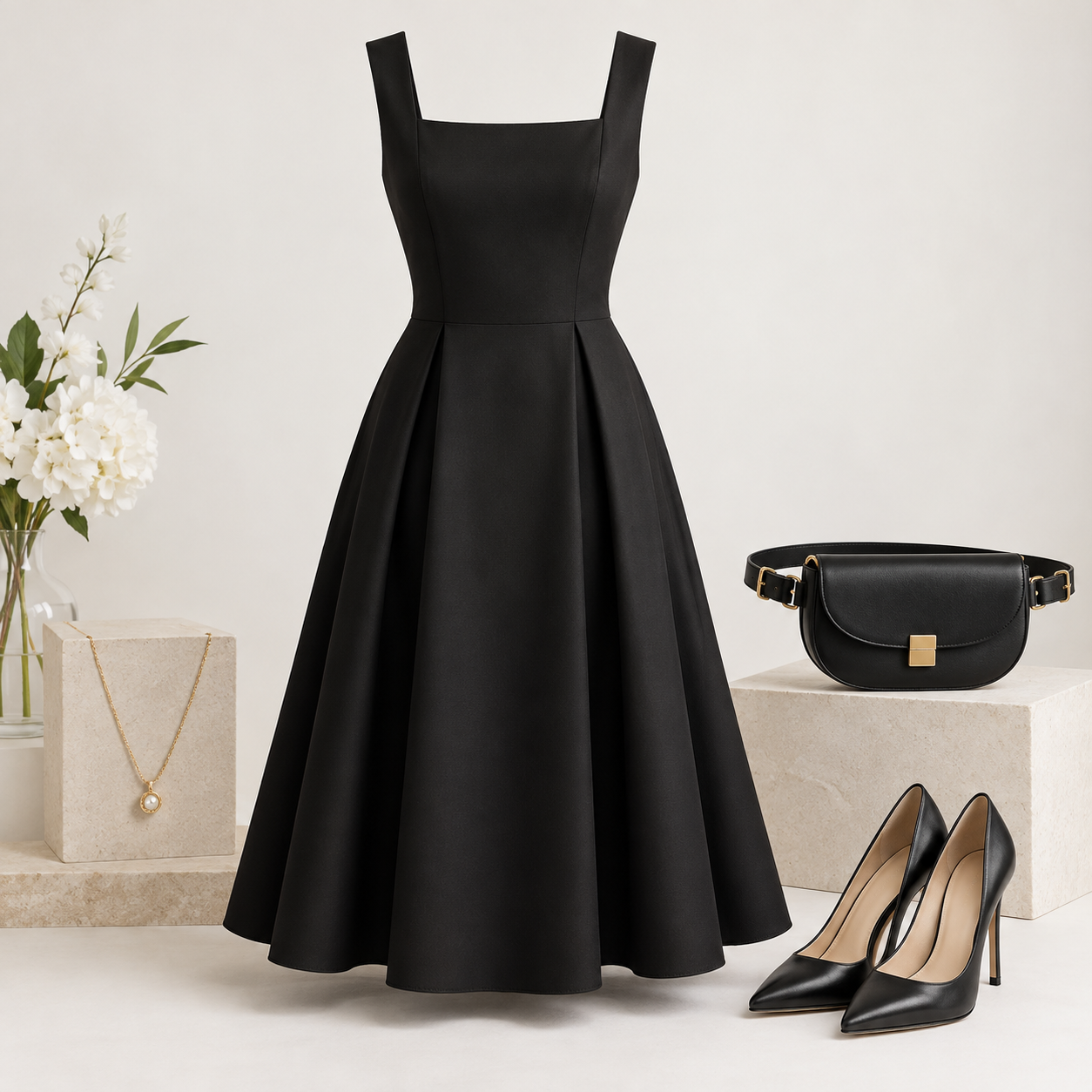
Provide Shoulder Space to Earrings.
Long earrings are worn beside the neck and shoulder. They can hit a high collar, catch lace or compete with a powerful sleeve. Small earrings can remain clear when the dress already creates volume near the face.
Include the hairstyle in the fitting.
Hair varies the background of an earring. Try them both together with the dress rather than on their own: the way to test an intended hairstyle. An earring worn under loose hair will be the focus when the hair is tied back.
Test What a Bag Does to the Surface.
A bag is not only a visual accessory; it is also in motion. Chains can snare lace or sequins. Velvet may be marked by rough leather, and satin can be rubbed by a rigid corner. A suitable color does not help when the bag damages the dress.
Carry the bag while walking.
Put the phone, keys and other necessary items inside, then walk and sit. Follow the strap path and where the bag rests. A handbag can be a better option when a fragile surface is involved; a crossbody bag can be effective when the material and bodice can bear its weight.
Place Belt around the Dress Construction.
A belt must not cover a waist seam, flatten a hidden zip or trap gathers unless it is done on purpose. The belt on a black dress can appear plain but quietly alter the hang of the dress.
Check the cloth 10 minutes later.
Secure the belt at a comfortable level and sit down. Remove it after several minutes to check for crushed pile, stretched fabric or gathers that are out of place. When the original waist comes back neatly, the accessory is working with the construction.
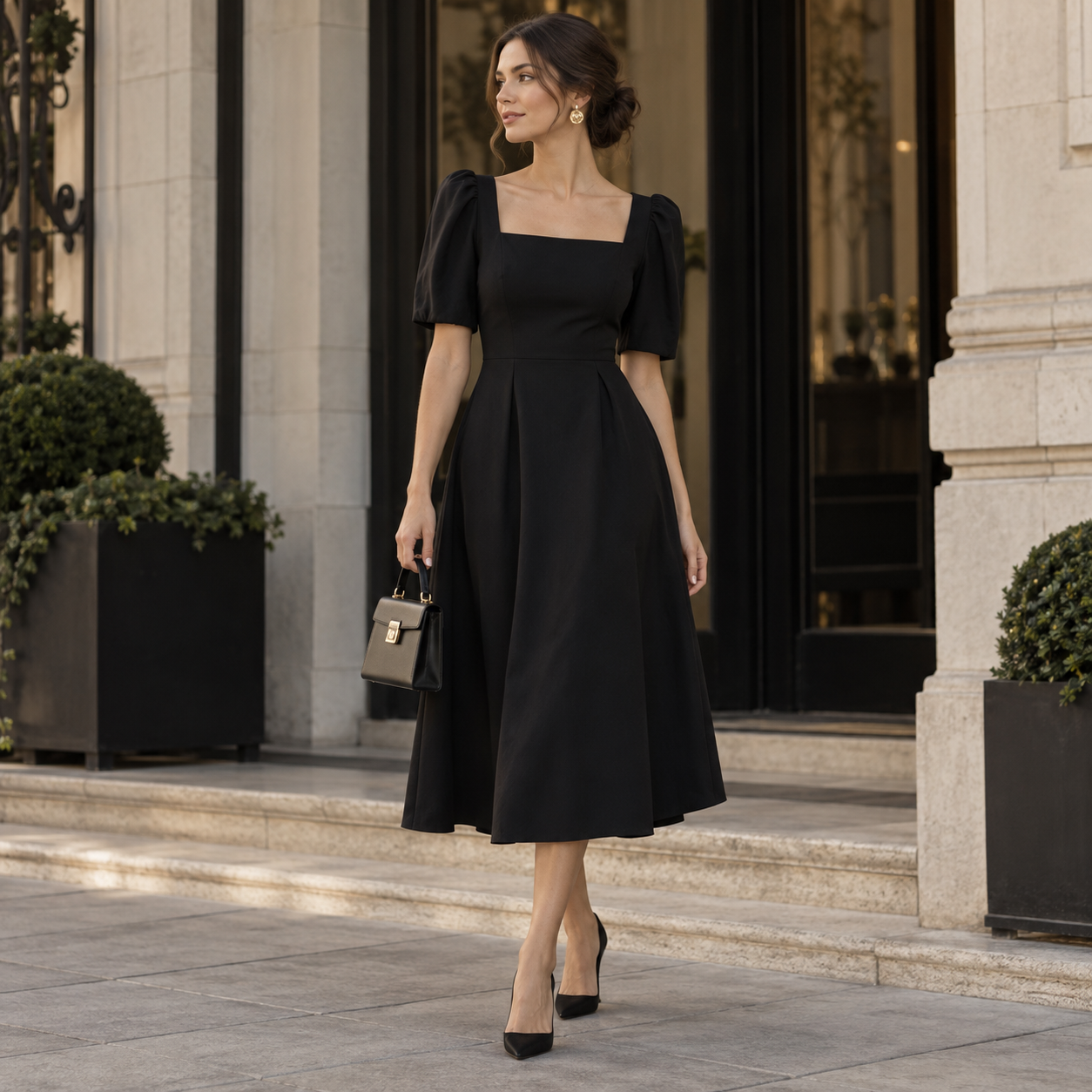
Keep Bracelets Away From Fragile Areas.
When the hands are at the waist, lifting the skirt or carrying a bag, bracelets and rings touch the dress. Mesh, lace and fine knits can be tangled by prongs, open links and rough settings.
Conduct a precautionary snag check.
Do not rub jewelry on the finished garment. Compare it with another similar fabric or check all the edges manually. Smooth pieces are less risky when the dress includes fragile sleeves or the wearer will handle the skirt regularly.
Make the Hem and Shoe Work Together.
Through their visible toe, fastening and surface, shoes are accessories to a black dress. They are also directly under moving cloth. A fluid or low hem may be trapped by rhinestones, exposed zips and long ankle ties.
Take a full step.
Take a step forward, turn and climb a stair. Make sure that the toe decoration is not in contact with the front and that the heel does not catch the back of the skirt. Color and shape are important only when the dress can safely move over the shoe.
● Secure long ankle ties.
● Cover sharp sides of buckles.
● Check boot zips against the inner hem.
● Remove loose shoe decorations under a full skirt.
Vary the Occasion With a Single Contact Point.
A black dress can pass between the day and evening without changing all the accessories. Alter one object at a single point of contact: shoes at the hem, earrings near the face or a bag at the hip. Keep the rest of the areas quiet enough so that change can be felt.
Assemble a mini transition kit.
A small bag and evening earring can be put in a daytime tote. A shoe change works when the dress length is appropriate to both pairs. The result should be a practical transition rather than an entirely separate outfit carried all day.
Add Accessory Testing to Black Dress Development.
In the case of a clothing line, accessory contact can reveal problems that a static sample fitting cannot detect. Neckline depth, embellishment placement, belt loops, pocket position and the overall sweep of the skirt should be approved after testing realistic items.
Note location of wear.
Dongguan Siyinghong Garment Co., Ltd. is involved in custom dress manufacturing and black party dress production. During a sample inspection, typical jewelry, bags, belts and shoes can be checked to identify snagging, pressure and placement issues before production.
Siyinghong black party dresses
CTA: Discuss a Custom Black Dress Sample
Finish by Removing Unnecessary Contact.
Put on the entire outfit and practise the movements expected during the event. When two accessories collide several times, cover the same feature or need to be adjusted, take one away. The remaining pieces must have a distinct position and a proper reason to remain.
Keep the dress recognizable.
The effectiveness of accessorizing is not determined by how many items black can carry. It allows the cloth, line and motion of the dress to remain visible while the other elements do their work without encroaching on them.
FAQ
Would it be appropriate to wear a black dress together with gold or silver?
Both can work. Test the metal against the fabric finish and event lighting, and check whether there is visible hardware on the dress.
Should a black dress have a necklace?
No. If the neckline has minimal free space or already has detailing, earrings or a bracelet can produce a cleaner result.
Do shoes and a bag go with a black dress?
They do not need to match. They should share a clear relationship in formality, finish, color or scale without conflicting with each other.
What is the number of statement accessories?
One obvious statement is usually enough. It can be supported by other pieces, but they must not obstruct the same contact area or damage the dress.
Post time: Sep-18-2026